Key Takeaways
- UAE banks are safe, with a capital adequacy ratio of 17% and a liquidity coverage ratio exceeding 146.6%, significantly above international requirements.
- Remittance services in the UAE are operating normally, with major exchange houses and platforms processing transfers without disruption.
- The UAE dirham is stable and pegged to the US dollar at 3.67, a mechanism that has held steady through past regional crises.
- The UAE Deposit Guarantee Scheme protects eligible deposits up to AED 100,000 per depositor per bank, with a strong historical track record of government intervention for depositor protection.
- Households should maintain a small cash buffer of AED 500 to AED 1,000 for emergencies, but large withdrawals from banks are unnecessary and create risks.
Four questions every expat in RAK is quietly asking this week. Here are the straight answers.
There is a version of financial anxiety that does not announce itself loudly. It arrives in the middle of a Tuesday evening when you find yourself opening your banking app for no particular reason, or when you calculate in your head how much you have transferred home this month versus how much is still sitting in your UAE account. If that sounds familiar, you are not alone – and you deserve a direct answer rather than vague reassurances.
This article covers the four things RAK expats are actually worried about right now: whether their bank deposits are safe, whether they can still send money home, whether the dirham is going to lose value, and whether keeping some cash at home makes any sense. Every answer here is grounded in what the UAE’s financial authorities have actually said and what the data actually shows.
Is Your Bank Account Safe?
The short answer is yes – and the Central Bank of the UAE has put its credibility behind that statement in writing.
On 5 March 2026, UAE Central Bank Governor Khaled Mohamed Balama issued a formal press statement from Abu Dhabi. The language was direct: banks, financial institutions, and insurance companies across the UAE are operating normally and providing services without disruption. He went further and published the specific numbers that back the statement up.
The UAE banking sector currently holds a capital adequacy ratio of 17 percent – comfortably above the international regulatory minimum of around 10.5 percent under Basel III standards. The Liquidity Coverage Ratio exceeds 146.6 percent, well above the global regulatory threshold of 100 percent. Total assets across the UAE’s banking and financial sector have reached AED 5.42 trillion (approximately $1.48 trillion). These are not talking points – they are audited regulatory figures published by the central bank.
What that means in plain language: UAE banks hold significantly more capital and liquid assets than they are required to by international standards. They are built to absorb shocks precisely because the UAE has lived through previous regional turbulence and has structured its financial system accordingly.
The Governor’s full statement included a specific reference to this track record: “Despite the successive geopolitical developments witnessed across the region during this period, the Central Bank and the UAE’s banking and financial sector have consistently demonstrated a strong capacity for resilience, adaptability, and sustained growth.”
That is not a government official saying “don’t worry.” That is a central banker citing a documented history of stability through prior crises.
What About the App Outages Some Banks Had?
This is worth addressing directly because it caused understandable anxiety in the first days of March.
Several UAE banks did experience digital service disruptions in the first week of the regional tensions. Abu Dhabi Commercial Bank (ADCB) saw its mobile banking and customer contact centre go offline for approximately 48 hours. Customers of First Abu Dhabi Bank (FAB), Emirates NBD, and Emirates Islamic also reported intermittent access issues with digital services.
According to The National, ADCB confirmed that services were fully restored and – critically – that at no point during the disruption were customer data, accounts, or the security of the bank’s systems compromised. The bank did not disclose the cause of the disruption publicly, though reports linked the timing to a fire at an Amazon Web Services data centre in the UAE.
These disruptions were a technology infrastructure issue, not a banking system failure. The distinction matters enormously. Your money did not go anywhere. The underlying accounts, balances, and transactions were unaffected throughout. You temporarily could not see them through an app – which is frustrating but is a different category of problem entirely from a bank being in financial difficulty.
All affected services have since returned to normal operation.

Is There a Deposit Guarantee Scheme in the UAE?
This is where the picture is slightly more nuanced than in some other countries, and it is worth being honest about.
The UAE introduced a statutory Deposit Guarantee Scheme (DGS) under a 2018 law, which protects eligible deposits up to AED 100,000 per depositor per bank if a bank were to fail. This aligns the UAE with global standards – the US guarantees up to $250,000 through the FDIC, and the EU guarantees up to €100,000 through national deposit guarantee schemes.
The AED 100,000 limit means that if your total deposits at a single UAE bank are below that threshold, you are covered by the statutory scheme in the event of that bank failing. If your deposits exceed AED 100,000 at a single institution, the amount above the threshold would be subject to the bank’s asset recovery process in liquidation.
Two practical points worth knowing. First, the UAE has a strong track record of government intervention to protect depositors even before the formal DGS was in place – during the 2008 global financial crisis, the UAE government guaranteed all deposits in UAE banks in full. Second, the banks most RAK expats use – RAK Bank, Emirates NBD, FAB, ADCB, Mashreq – are among the largest, most capitalised institutions in the region. The probability of any of these institutions failing is extremely low by any credible measure.
If you bank with a smaller institution and have significant savings, it is worth knowing the AED 100,000 DGS limit and whether your balance exceeds it. <div class=”wow-expert-tip”>
WOW-RAK Expert Tip: RAK Bank (National Bank of Ras Al Khaimah) is the emirate’s home-grown institution and one of the UAE’s well-capitalised banks. If you are an expat in RAK and want the combination of a local presence, English-language service, and the full CBUAE regulatory framework, RAK Bank is the natural starting point. Their expat account and salary card products are designed specifically for the UAE’s international workforce.
Can You Still Send Money Home?
Yes. Remittance services in the UAE are operating normally.
The UAE is the second-largest source of outbound remittances in the world, behind only the United States. Approximately AED 169 billion leaves the UAE in personal remittances every year, flowing to India, Pakistan, the Philippines, Egypt, the UK, the US, and dozens of other destinations. This system is deeply embedded infrastructure – it does not pause because of regional tensions.
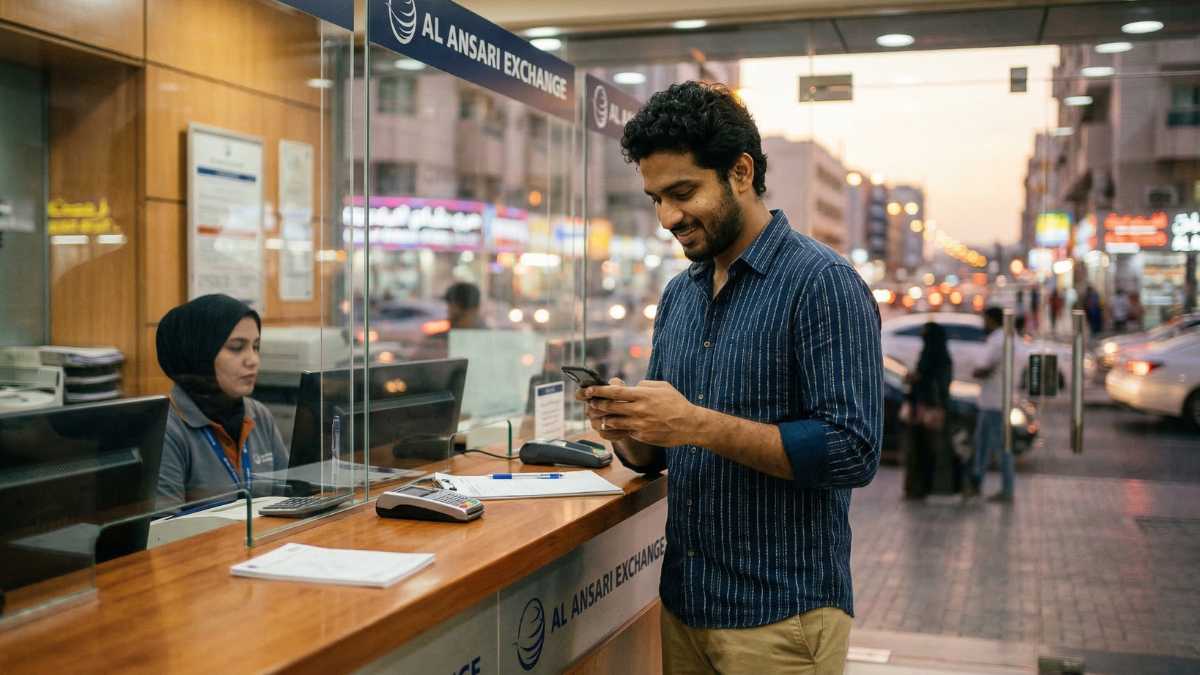
All major exchange houses and remittance platforms in RAK and across the UAE are currently operating. Al Ansari Exchange, LuLu Exchange, Al Fardan Exchange, Wall Street Exchange, and Sharaf Exchange are all open and processing transfers normally. Digital platforms including Wise, Remitly, Western Union, and Al Ansari’s own app are all functioning.
For Indian expats specifically – who make up a significant portion of RAK’s population and send a substantial share of their earnings home monthly – the India remittance corridor is one of the highest-volume and most resilient transfer routes in the world. According to data cited by Gulf News, the UAE accounts for approximately 19 percent of India’s total inward remittance flow. That corridor has never been interrupted by regional tensions and has continued operating through every period of Gulf turbulence in living memory.
For Filipino expats, the Philippines-UAE remittance corridor is similarly entrenched. Major services used by the Filipino community – Western Union, LuLu Exchange, and digital platforms – are all processing normally.
For South Asian expats more broadly (Pakistan, Sri Lanka, Bangladesh), the same applies. Exchange houses process these transfers daily and the major corridors are operating without disruption.
For Western expats sending money to the UK, Europe, or the US, Wise remains the most cost-efficient option for larger transfers and is operating normally. Bank wire transfers through SWIFT are also unaffected.
Is There Anything to Watch With Remittances Right Now?
One practical note worth flagging. Exchange rates on some currency pairs have seen more movement than usual in recent weeks due to global market volatility around the regional situation. This affects the amount your family receives at the other end even if your UAE dirham amount stays the same.
If you are sending a significant sum, it is worth checking the rate across two or three services before sending rather than defaulting to your usual provider. The difference between the best and worst rate on a large transfer can be meaningful. Wise is generally the most transparent on exchange rate markup. Al Ansari and LuLu Exchange are competitive for South Asian and Southeast Asian corridors specifically.
One service worth noting: Taptap Send temporarily paused UAE transfers while upgrading its system (reported by Gulf News in late 2025, separate from current events). If you use Taptap Send and find it unavailable, Al Ansari’s app and Wise are the most straightforward alternatives.
Will the Dirham Lose Value?
No. The UAE dirham has been pegged to the US dollar at a fixed rate of 3.67 since 1997. This peg is backed by the UAE’s substantial foreign exchange reserves and has held without interruption through every period of regional turbulence in the past three decades – including the Gulf War, the 2003 Iraq invasion, the 2006 Lebanon conflict, the 2008 global financial crisis, the 2011 Arab Spring, the 2019 Gulf of Oman incidents, and the Covid-19 pandemic.
The peg is not a promise – it is a structural mechanism maintained by the Central Bank of the UAE and backed by sovereign wealth. The Abu Dhabi Investment Authority (ADIA) manages assets estimated at over $1 trillion. The UAE does not have a currency depreciation problem. It has one of the most stable currencies in the world for exactly the reason that it is tied to the world’s reserve currency.
What this means practically: if you are a South Asian expat sending money home and your home currency weakens against the dollar during a period of global uncertainty – as often happens – your remittances are actually worth more in local currency terms at the receiving end. The peg works in your family’s favour when global risk aversion is high.
For Western expats: the pound, euro, and dollar exchange rates against the dirham are determined by what happens to those currencies against the US dollar, not by anything happening in the UAE. Sterling weakness or euro weakness reflects UK or eurozone dynamics, not UAE financial stability.
Should You Keep Cash at Home?
A small, practical household emergency fund is always sensible regardless of the current situation. This is standard financial preparedness advice, not a crisis response.
The honest position is this: keeping AED 500 to AED 1,000 in cash at home – enough to cover a few days of groceries, petrol, and incidentals if you could not access a bank for any reason – is reasonable for any household anywhere. It has nothing to do with the current situation specifically.
What you should not do: withdraw large amounts of cash from the bank out of anxiety. This creates unnecessary risk (cash at home can be lost, stolen, or damaged), earns you nothing while sitting in a drawer, and if done at scale contributes to the kind of pressure on banking systems that can become self-fulfilling.
UAE ATMs and bank branches are all operating normally. There are no queues, no withdrawal limits, and no reason to hold more cash than your normal household buffer.
If you feel the need to do something practical, the most useful financial action you can take right now is to make sure you know where your important documents are – your passport, Emirates ID, insurance cards, bank account details – and that you have taken photos of them stored somewhere secure. That is practical preparedness for any expat in any situation.
The Big Picture: The UAE as a Financial Safe Haven
One detail from the Central Bank’s statement that did not get much attention in the news coverage: total assets across the UAE banking sector now exceed AED 5.42 trillion. To put that in context, the UAE’s annual GDP is approximately AED 1.7 trillion. The banking system holds assets worth more than three times the country’s annual economic output. That is a deeply capitalised system.
The UAE has spent the past two decades deliberately positioning itself as the financial safe haven of the Middle East – the place that money and people run to when other parts of the region face instability, not the place they run from. That positioning has attracted the DIFC, the ADGM, and hundreds of international financial institutions precisely because of this track record.
The current moment is actually a test of that positioning – and so far, based on the capital adequacy ratios, the liquidity figures, the continued operation of Nasdaq Dubai, and the absence of any capital flight data, the UAE financial system is passing the test.
Summary: What to Actually Do
Your bank deposits are safe. Keep using your account normally.
Remittances are flowing. Send money home as you normally would, and compare rates across two or three services if sending a large amount.
The dirham is not going anywhere. It has been pegged to the dollar for almost 30 years and the mechanism is sound.
Keep a small household cash buffer of AED 500 to AED 1,000 as standard preparedness – not as a crisis response.
If you experienced an app outage in the first week of March with ADCB, FAB, Emirates NBD, or Emirates Islamic – services are now fully restored and your accounts were unaffected throughout.
FAQs
Yes. The UAE Central Bank confirmed on 5 March 2026 that all banks are operating normally, with a capital adequacy ratio of 17 percent and a liquidity coverage ratio above 146.6 percent – both significantly above international requirements. Total banking sector assets exceed AED 5.42 trillion.
Yes. Al Ansari Exchange, LuLu Exchange, Al Fardan Exchange, Western Union, Wise, Remitly, and all major remittance platforms are operating normally. All major corridors – India, Philippines, Pakistan, UK, US – are processing transfers without disruption.
No. The dirham has been pegged to the US dollar at 3.67 since 1997 and has maintained that peg through every regional crisis in the past three decades. There is no credible mechanism by which the current situation would break this peg.
The UAE Deposit Guarantee Scheme covers eligible deposits up to AED 100,000 per depositor per bank. The UAE government has also historically intervened to protect depositors beyond the formal scheme – as it did for all deposits during the 2008 global financial crisis.
Several UAE banks experienced digital service disruptions in the first days of March, reportedly linked to an AWS data centre fire. ADCB was offline for approximately 48 hours before full restoration. Account balances and customer data were unaffected throughout. All services have since returned to normal.
No, beyond a normal household buffer of AED 500-1,000. ATMs and bank branches are fully operational with no restrictions. Large cash withdrawals create personal risk and serve no financial purpose when the banking system is operating normally.
Yes, especially for larger transfers. Global market volatility has increased currency movement on some pairs, and the difference between best and worst exchange rates across services can be meaningful on a large sum. Wise is the most transparent on rate markup. Al Ansari and LuLu Exchange are competitive for South Asian and Southeast Asian corridors.
For the broader picture on safety and stability in RAK during the current regional situation, read our anchor guide: Is RAK Safe Right Now?. For questions about grocery prices and food supply, see Are Grocery Prices Really Going Up in RAK?. For visa and employment legal questions, see our Top Legal Questions for Expats guide.